Thursday, April 14, 2016

How to Get Through High School

How did you identify yourself in high school? Were you a nerd, jock, geek, loner, or prep? In the comedy TV show "Freaks and Geeks" only two groups roam the halls of McKinley High: the freaks and the geeks. "Freaks and Geeks" tells the story of Lindsay Weir, a former geek who tries to fit in with the stoner freaks, and her little brother Sam, a nerd trying to find his place in high school. The TV show was released in the 1990s, but focuses on high school in the 1980s. There are 18 episodes of the TV show, but only 12 were aired before it was cancelled. Due to its cult following, the other episodes were eventually broadcast and are now available on Netflix.

The show follows Lindsay (Cardellini), a former "Mathlete" and A student who decides she wants to befriend the "Freaks:" Daniel (Franco), Ken (Rogen), Nick (Segel), and Kim (Philipps). Throughout the series, Lindsay struggles to prove that she belongs with the freaks without breaking too many rules. Meanwhile, her brother, Sam, and his friends try to survive high school.

What I like best about Freaks and Geeks is that it captures high school in an exaggerated, but accurate way. Everyone is trying to find themselves and fit in while maintaining their basic principles. For example, in one episode, Lindsay decides to throw a party while her parents are away. Sam nervously agrees, but he and his friends swap out the beer with nonalcoholic beer, so they won't get in trouble. The partiers don't notice and act drunk anyway. During the party, Sam and his friends are the only ones getting tipsy. It's quirky plot lines like these that make Freaks and Geeks so funny and also so relatable.


Freaks and Geeks kickstarted the careers of many famous actors and actresses including James Franco, Seth Rogen, Linda Cardellini, Jason Segel, John Francis Daley, Busy Philipps, and Martin Starr. It also received three Emmy nominations and is consistently ranked as one of the best TV comedies.

I highly recommend you watch at least one episode of this classic show. It's on Netflix, so go check it out!

In the meantime, here are some of the best lines:

Sam's friend: Wait a minute. If I think I’m cool then people will think I’m cool too? But I already think I’m cool. But nobody else does.


Sam's friend: If you don’t care about high school, you won’t get into a good college, and no future and you’ll wind up dead or in jail.


Teacher: Last one to class, first one on welfare. Your choice.

Mr. Weir: Who the hell did this to you, Sam?
Sam: Some freaks.
Mrs. Weir: Freaks? Like circus freaks?
Mr. Weir: Jean, I don’t think there’s bearded ladies running around throwing eggs at kids.


Mr. Weir: You know who used to cut class? Jimi Hendrix. Know what happened to him? He died.

And my personal favorite...

Mr. Weir: You know, everyone’s a Democrat until they get a little money. Then they come to their senses.

Enjoy!

Photo courtesy of Flickr

Thursday, April 7, 2016

Raising Morale (and Hell)

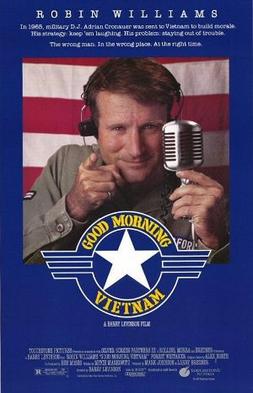
In "The Things They Carried," a book by Tim O'Brien, a soldier from the Vietnam War, he describes the drudgery of daily war life: "I remember the monotony. Digging foxholes. Slapping mosquitoes. The sun and heat and endless paddies. Even deep in the bush, where you could die any number of ways, the war was nakedly and aggressively boring." O'Brien was not the only one with this opinion. During the Vietnam War, many soldiers were not only bored, but also disillusioned with the American government's policy. This led to low levels of army morale. In order to boost the soldiers' spirits, the United States army hired a DJ named Adrian Cronauer to cheer soldiers up using his radio broadcast. The movie I've chosen to focus on this week, "Good Morning, Vietnam" is loosely based off of his experiences.

"Good Morning Vietnam," a comedy, starring Robin Williams as DJ Cronauer, was released in 1987. It follows DJ Cronauer as he works to restore enthusiasm among the American soldiers stationed in Saigon, Vietnam. His daily program always begins with him saying "Gooooooooood morning, Vietnam!" followed by his routine of unpredictable humor, military updates, and rock and roll music (all of which irritate his superiors). Despite the fact that he is not ranked very highly in the military, Cronauer makes his own orders and is not afraid to disrespect his superiors if he thinks he is making the right call. Often, he chooses to release information to soldiers that the military wants to keep classified because he believes that they have a right to know what is happening in the country.

Cronauer becomes popular among the American soldiers who love his style and genuine interest in their lives. They are so passionate about his broadcasts that after he is suspended (for releasing classified information) they send in letters and phone calls demanding that he is returned. While this is happening, Cronauer himself has become disillusioned with the army. Even though he is told that he can return to his job, he refuses. Until, one day, he comes across a group of soldiers departing for battle and they ask him for an impromptu broadcast. He then realizes the impact of his work and decides to return.

One of my favorite parts of the movie is when Cronauer decides to teach English to some Vietnamese locals. He takes advantage of this opportunity to teach them slang phrases and American curse words.  Through this experience, he makes friends with the people of the country. I think this is an important decision on the screenwriter's part because it illustrates the idea that, at the end of the day, we are all human. The war was a horrifying experience for both sides and many argue that the war didn't change anything. All it did was kill innocent people. It also encapsulates the public sentiments at the time that we should not have been involved in the first place.

I think this film also demonstrates the power of humor and how it can make people feel better. The soldiers loved Cronauer because he would tell them what was really going on and try to make light of their circumstances. He was there for them as they took on a foreign country with an enemy they could not understand.

Overall, I think this movie has a powerful messages about war and humanity. It also manages to incorporate good humor, history, and music (including The Beach Boys and Louis Armstrong)! If you're interested in learning more, check out the trailer below:


Photo courtesy of Wikipedia
Video - YouTube user 05HK09

Thursday, March 31, 2016

Competition at Its Best

Nice guys finish last. At least, that's what Freddy Benson (Steve Martin) and Lawerence Jamison (Michael Caine) believe in the 1988 comedy film Dirty Rotten Scoundrels. The story follows these two men as they compete to swindle wealthy women out of money. But, they have two very different ways of approaching their chase.

Lawerence Jamison, the debonair, aristocrat, has gained his wealth from preying on exceedingly wealthy and corrupt American women vacationing in his French hometown Beaumont-sur-Mer. With the help of his friend in the police force, he spins a tale that centers on him as the poor Prince trying to liberate his country. It works, as evidenced by one of his victims who says, "Oh, your highness, I don't want money from a man who needs every penny to feed his enslaved people." But, while Lawerence is intentionally deceitful, he vows to only con women who can afford it.

Then, there's Steve Martin's character, Freddy Benson, an American con-artist who will target anyone who falls for his sob story about his grandmother:
"She's been quite ill lately. The hospital bills have been adding up. I just want to do my share. It's tough for me because I was never good with money... But I am going to help my Gram-Gram. She is the one who taught me: it is better to be truthful and good, than to not."


The two meet when Freddy is on the way to Beaumont-sur-Mer with big plans of scamming the local population. Seeing Freddy as competition that might "scare big game away," Lawerence decides that  he needs to get rid of him - fast. After his attempts to mislead Freddy into leaving Beaumont-sur-Mer do not work, Lawerence decides to keep his enemy close and teach him his ways. The two of them tag-team with Lawerence acting as the suave Prince in need and using Freddy as his mentally challenged brother to scare the women away after the money has been collected. After awhile, Freddy becomes frustrated with his secondary position and decides to go back out on his own.


The two reach an impasse as neither is willing to leave the area. They decide to make it into a final competition: the first of them to con $50,000 out of a rich, but naive American heiress will be allowed to stay. The loser will leave. The two select Janet Colgate, a young lady who fits the description, and venture into their schemes. As the two compete for Janet's purse, they are constantly spying and adapting to each other's tactics in order to beat out the other person.

While this film does not have much base in reality, it does hit on some common American trends. For example, in the U.S. we have always valued those who work hard and move up the ladder due to their own accomplishments. The women "victims" in the movie were born into extreme wealth and have never felt the hardship of working. So, even though the women are being taken advantage of, we don't see them as victims. In fact, we see Freddy and Lawerence as the anti-heroes who use their cleverness and charm to deliver a Robin Hood-esque justice (even if they do not share their spoils). While this film is a fun and entertaining watch, it also gives us a window into the American ethos.

Now, I must disclose, that this is one of my favorite movies (if not, the favorite movie). So, I highly encourage you to watch it. But, if you don't have a chance, here are some of the best quotes:

Freddy Benson: I didn't steal any money! She just saw me with another woman! You're French, you understand that!

Policeman: To be with another woman, that is French. To be caught, that is American.


Freddy Benson: Listen. We're the weaker sex. Men don't live as long as women. We get more heart attacks, strokes and prostate trouble. I say, it's time for a change. I say, let them give us money. Let's live off them for a while.

Photo courtesy of Wikipedia and videos courtesy of MovieClip

Sunday, March 20, 2016

For the Stars and the Stripes

Have you ever thought your life was a failure? How did you recover from that? What did you do? What was your next step?

In Stripes, a military comedy film released in 1981, the main character, John Winger (Bill Murray), loses his job, his car, his apartment, and his girlfriend, all within a few hours. Believing his life is a failure, he decides to join the United States Army. Not wanting to go alone, he ropes his friend Russell Ziskey into embarking on this adventure with him.

The two set off for basic training at Fort Arnold. Throughout training, John's good humor, and occasional questioning of authority, lead him to stand out from the other recruits (not in a good way). He and the other recruits manage to scrape by through most of their training leading up to graduation. Although, only a little before graduation, the group's drill sergeant becomes injured, leaving them in the hands of the inept commanding officer, Captain Stillman. With no one to lead them, it becomes unclear whether the group will actually be able to graduate into the military.

The night before the graduation ceremony, John gives the group a motivational speech and convinces his fellow trainees to spend the night drilling in preparation for graduation. The next morning, they sleep in and almost miss the graduation ceremony. But, they manage to deliver a coordinated, if untraditional, drill display that (surprisingly) wows the General. The General allows them to graduate and decides to deploy them to Italy.

In Italy, their assignment is to guard an assault vehicle, but John and Russell get bored with their duty and decide to take the vehicle to go visit their girlfriends (from basic training) who are stationed in West Germany. When Stillman realizes that the vehicle is missing, he leads the remaining platoon members on a search. The platoon accidentally ends up in Czechoslovakia where they are captured. John and Russel hear of the capture and realize they must go find their friends. John, Russell, and their girlfriends must save the platoon by infiltrating a Russian base.

This extremely hilarious movie makes light of what was a tension-filled time in American history. During the time the movie was released, the Cold War was souring US-Soviet relationships and many people still remembered World War II. While the movie wasn't strictly anti-war, it in many ways, reflected the anti-establishment feelings of the time. John Winger's character continues to question military authority throughout the film, showing the skeptical attitude of the 1980s youth. While it makes for some funny conversations, the sentiment beneath the humor resonates with this generation.

Now, for some of my favorite quotes:

Army Recruiter: Have you ever been convicted of a felony or a misdemeanor? That's robbery, rape, car theft, that sort of thing.

John: Convicted? No.

Russell: Never convicted.


Russell: I've always been kind of a pacifist. When I was a kid, my father told me, "Never hit anyone in anger, unless you're absolutely sure you can get away with it." I don't know what kind of soldier I'm gonna make, but I want you guys to know that if we ever get into really heavy combat... I'll be right behind you guys. Every step of the way.


John: We're all very different people. We're not Watusi. We're not Spartans. We're Americans, with a capital 'A', huh? You know what that means? Do ya? That means that our forefathers were kicked out of every decent country in the world. We are the wretched refuse. We're the underdog. We're mutts! ...We're all very, very different, but there is one thing that we all have in common: we were all stupid enough to enlist in the Army. We're mutants. There's something wrong with us, something very, very wrong with us. Something seriously wrong with us - we're soldiers. But we're American soldiers! We've been kicking [butt] for 200 years! We're ten and one! Now we don't have to worry about whether or not we practiced. We don't have to worry about whether Captain Stillman wants to have us hung. All we have to do is to be the great American fighting soldier that is inside each one of us. Now do what I do, and say what I say. And make me proud.

Photo courtesy of Wikipedia

Thursday, March 17, 2016

The New "Who Dun It?"

You may have heard of a "whodunnit" story, but what about a "howcatchem?"

For those of you who have no idea what I'm talking about, "whodunnit" generally refers to a storyline where the audience follows the narrator as he or she tries to discover who committed a crime. The audience forms their own opinion throughout the story, reformatting it when new evidence comes to light. This type of storytelling became popular in the early 20th century and by the middle of it, some people wanted to find a new way of exploring a mystery that would still engage the audience.

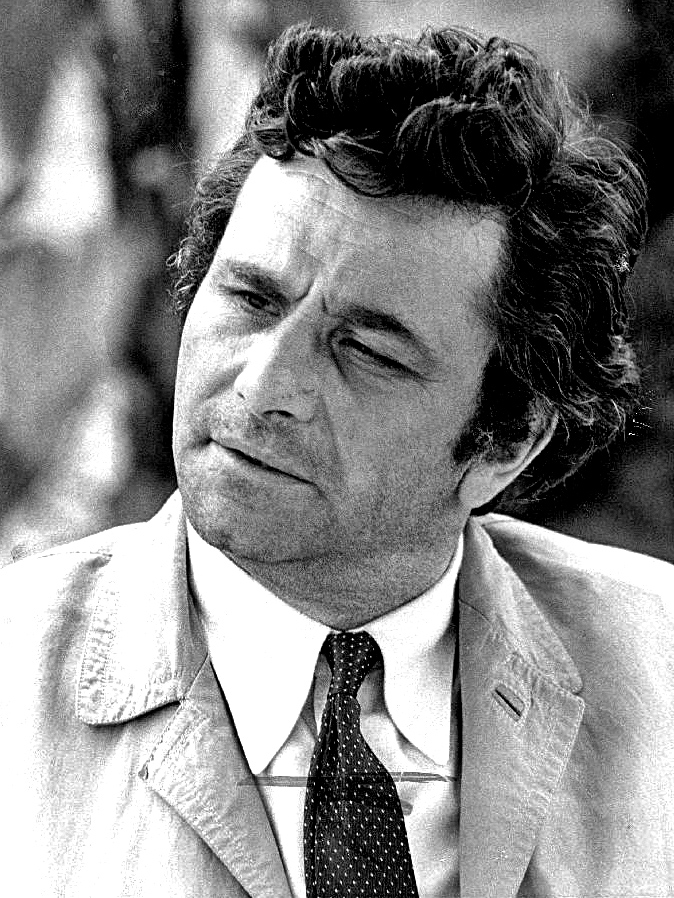
In the early 1960s, William Link and Richard Levinson decided they were going to do just that and they created what they called the "howcatchem" story through the TV series Columbo. Instead of focusing on who committed the crime, the series instead centers on how they are caught. At the beginning of every episode, the audience sees the criminal committing the offense. Then, the main character Lieutenant Columbo spends the majority of the episode teasing out a confession from the perpetrator.

Columbo is not your average lieutenant. He wins his cases by pestering the suspect and leading them to believe that he is incompetent. They finally become so annoyed with him that they let down their guard and expose themselves as guilty. Despite his absentmindedness and disheveled appearance, he still manages to solve every case.

One of my favorite aspects of Columbo's style is that he will often throw in anecdotal evidence about his wife or another relative in order to relate to the suspect as a friend or to make them underestimate him. At one point after asking a lot of questions about the case to a potential suspect Columbo says, "I worry. I mean, little things bother me. I'm a worrier. I mean, little insignificant details - I lose my appetite. I can't eat. My wife, she says to me, 'you know, you can really be pain,'" in order to make the suspect think that he is asking questions that do not actually pertain to the case.

Another interesting element of the series is that Columbo is usually dealing with someone who is wealthier or who has more influence than he does. This naturally makes him appear to be an underdog, which I think is one of the reasons why the show was so popular. People liked the idea of supporting someone who stood for justice and who also was, at the end of the day, a common, working-class man.

It's really hard to do justice to Columbo's character through writing, so I encourage all of you to take a study break and watch a show - it's on Netflix!

And for now, enjoy these quotes:

Dr. Ray Flemming: I want the man who murdered my wife. Everything else is irrelevant. 

Lt. Columbo: Well, I'm only trying to... 

Dr. Ray Flemming: I know. You're only trying to tie up loose ends. Well, if you spent a little less time on loose ends, maybe you'd come up with something important. You know, sometimes I get the impression you think I killed my wife. 

Lt. Columbo: You? Oh, no, Doc. How could you? You were out of town. 

Dr. Ray Flemming: I'm glad you remembered that. Unless you think I hired someone to kill her. The boy who confessed? Maybe I paid him to do it. 

Lt. Columbo: No, Doc, you didn't do that. 

Dr. Ray Flemming: How do you know? 

Lt. Columbo: I already asked him.

________________________________________________________________________________

Lt. Columbo: You're probably right. [The murderer] sounds just too clever for us. What I mean is, you know, cops, we're not the brightest guys in the world. Of course, we got one thing going for us: we're professionals. I mean, you take our friend here, the murderer. He's very smart, but he's an amateur. I mean, he's got just one time to learn. Just one. And with us, well, with us, it's - it's a business. You see, we do this a hundred times a year. I'll tell ya, Doc. That's a lot of practice.

Photo courtesy of Wikipedia

Tuesday, March 1, 2016

How to Solve a Mid-Life Crisis

While none of us are old enough to have had a mid-life crisis, we all can relate to those days where we feel lost, where we question every decision we have ever made in our lives. And (usually) we find a way to overcome our temporary uncertainty. We talk to friends and family or clear our heads by going for a run. We end the day back on track. In the movie "City Slickers," main character Mitch Robbins has a mid-life crisis, but unlike you and me, he solves it a little differently.


When Mitch turns 39 and starts coming to grips with the reality of his life (see his outburst above), his two friends Phil and Ed come up with a solution: a two-week cattle drive in New Mexico. For Mitch and his friends, true city slickers, this will be a challenge.

They meet their first test in Curly, the no-nonsense trip leader. While Mitch is initially intimidated by him, after spending more time with him, he comes to see the wisdom in his words. Curly advises Mitch to find the one thing that is most important in his life and then with a new perspective, he can solve his problems.

Later, Curly passes away from a heart attack. The remaining group leaders leave and the other tourists decide to pack it in. But, Mitch and his friends decide to continue and finish the drive. They battle both nature and their issues as they try to drive the cattle to the finish line in Colorado.

It is definitely a stretch to say that this movie is culturally rich, but it does do a good job of poking fun at how uptight we can be as a society. At the end of the day, it is far more important to be happy with life than to be miserably going through the motions. For Mitch and his friends, the trip to New Mexico is a healthy dose of reality; it shows them what's important in life. Similarly, this movie tries to communicate the same message to its audience.

Here are some of the best quotes:

Mitch Robbins: Have you ever had that feeling that this is the best I'm ever gonna do, this is the best I'm ever gonna feel... and it ain't that great?

His Boss: Happy Birthday.


Mitch's friend Ed: The three of us, New Mexico... driving cattle.

Mitch Robbins: What, like in a truck?


Ed Furillo: This guy, Curly, is a true cowboy. One of the last real men. He's untamed, a mustang. It'll do us good to be in his world for a while.

[Curly is approaching them from behind Mitch]

Mitch Robbins: Do us good? Didn't you guys see? The man was hanging the hired help! And, did you notice his eyes? He has crazy eyes. He's a lunatic! We are going into the wilderness being led by a lunatic!

[Mitch notices everyone's terrified faces as Curly is standing directly behind him]

Mitch Robbins: He's behind me, isn't he?


Mitch Robbins: Hi Curly. Killed anyone today?

Curly: The day ain't over yet...


Mitch Robbins: Those cows trusted us.

Ed Furillo: Trusted us? They followed us because we yelled, 'Yah'. They're cattle.

Thursday, February 18, 2016

Is There Anyone Here Who Knows How to Fly a Plane?

"Ladies and gentlemen, this is your stewardess speaking... We regret any inconvenience the sudden cabin movement might have caused, this is due to periodic air pockets we encountered, there's no reason to become alarmed, and we hope you enjoy the rest of your flight... By the way, is there anyone on board who knows how to fly a plane?

[all hell breaks loose in the cabin]"


Imagine your worst fears of flying came true. The plane pilot and co-pilot are down for the count due to food poisoning. Most of the passengers are sick. The plane needs to land as soon as possible, so that everyone can be taken to the hospital. What do you do?

This is the basic plot of Airplane!, a comedy movie released in 1980 that parodied the disaster film genre. The film centers around Ted Striker, a former pilot who became traumatized by planes from an earlier war experience. After the war, his post-traumatic stress disorder caused him to lose his job and his girlfriend Elaine, who is a flight attendant. He decides to board the Trans American Flight 209 from Los Angeles to Chicago in the hopes of winning back Elaine. After it becomes clear that the pilots are out of commission, the responsibility to land the plane falls on Striker. He must rise to the challenge to save the crew and his relationship.

Amidst the struggle to land the plane, Airplane! hits on some hilarious - if not occasionally offensive - jokes and stereotypes. One of my personal favorites is when two African-American men are speaking in "jive" to a stewardess who cannot understand their slang, so an elderly white woman volunteers to translate.


Yet despite its use of improper language, Airplane! continues to be applauded as a culturally significant film. It, along with many of the other movies I have discussed, is preserved in the Library of Congress's National Film Registry because of the impact it made on American film and culture. Airplane! captured the public's frustration with the formulaic disaster movies that dominated during this time. It even used those same serious actors (from other disaster movies) to deliver these hilarious lines in the same deadpan style.

Through comedy, Airplane! was able to poke fun at the unoriginality found in 1970s films. Even though much of the script is verbatim from movies like Airport 1975, the writers put their own spin on the dialogue to create a film that is not only hilarious, but also critical of this cookie-cutter genre.

Airplane! continues to live on as (arguably) one of the best American comedies. Many people continue to quote its iconic lines today. If you have not seen it, I highly recommend you do. It is definitely worth it.

Here are some of my favorite quotes:

Lady: Nervous?
Ted Striker: Yes.
Lady: First time?
Ted Striker: No, I've been nervous lots of times.


Rumack: Captain, how soon can you land?
Captain Oveur: I can't tell.
Rumack: You can tell me. I'm a doctor.
Captain Oveur: No. I mean I'm just not sure.
Rumack: Well, can't you take a guess?
Captain Oveur: Well, not for another two hours.
Rumack: You can't take a guess for another two hours?


Rumack: You'd better tell the Captain we've got to land as soon as we can. This woman has to be gotten to a hospital.
Elaine Dickinson: A hospital? What is it?
Rumack: It's a big building with patients, but that's not important right now.


Rumack: The life of everyone on board depends upon just one thing: finding someone back there who can not only fly this plane, but who didn't have fish for dinner.

Enjoy the movie!